
Elizabeth de Burgh: Queen of Scots, Dynastic Hostage, and Royal Matriarch


In the dramatic history of the Wars of Scottish Independence, King Robert the Bruce stands out as the supreme warrior-king who secured his nation's freedom at Bannockburn. Yet behind the military triumphs and political struggle lies the poignant, resilient story of his second wife, Elizabeth de Burgh.
As Queen Elizabeth de Burgh, she endured eight arduous years of imprisonment, harsh isolation, and political captivity at the hands of King Edward I of England. Her life provides a compelling window into medieval cross-border diplomacy, the vulnerability of noble women during times of total war, and the sacrifices that forged the medieval Kingdom of Scotland.
This historical analysis explores the early origins of Elizabeth de Burgh, her strategic marriage to Robert the Bruce, her painful years as an English captive, her return to Scotland as queen consort, and her enduring royal legacy.
- Early Origins and Anglo-Norman Lineage
- The Strategic Union: Robert the Bruce and Elizabeth de Burgh
- The Royal Coronation at Scone (March 1306)
- Defeat, Flight, and Capture (1306)
- Eight Years of Imprisonment: Was Elizabeth de Burgh Kept in a Cage?
- Liberation and the Aftermath of Bannockburn (1314)
- Queen Consort of Scotland and Royal Children
- Elizabeth de Burgh Cause of Death and Final Days
- Essential Historical Summary: Elizabeth de Burgh
- Recommended Books and Reading Material
- Recommended video
- Frequently Asked Questions About Elizabeth de Burgh (FAQ)
Early Origins and Anglo-Norman Lineage
To understand the background of Elizabeth de Burgh, one must examine the immense power of her family within the Anglo-Norman aristocracy of fourteenth-century Ireland and England.

The Power of the "Red Earl"
Elizabeth was born around 1284, likely at Dunluce Castle or Connacht, Ireland. She was the daughter of Richard Óg de Burgh, 2nd Earl of Ulster—famously known as the "Red Earl"—and his wife Margaret.

Her father was the most formidable Anglo-Norman lord in Ireland, possessing vast estates across Ulster and Connacht, alongside extensive lands in England and Wales. The Earl of Ulster maintained close political ties with King Edward I of England ("Longshanks"), acting as a primary military deputy for English interests in the Irish Sea region.

As the daughter of such a prominent magnate, Elizabeth was raised in aristocratic comfort and educated in courtly French, Latin, and administrative management. Her high birth made her one of the most eligible diplomatic matches in the British Isles.

The Strategic Union: Robert the Bruce and Elizabeth de Burgh
The story of Robert the Bruce and Elizabeth de Burgh began not as a romantic tale, but as a calculated political alliance designed to heal cross-border rivalries.
How Old Was Elizabeth de Burgh When She Married?
A common query among medieval historians is: how old was Elizabeth de Burgh when she married Robert the Bruce?
The wedding took place in 1302 at Writtle, near Chelmsford in Essex, England. Based on genealogical records placing her birth around 1384, Elizabeth was approximately eighteen years old at the time of her marriage. Robert the Bruce, born in 1274, was around twenty-eight—a widower whose first wife, Isabella of Mar, had died in 1296 after giving birth to his daughter, Marjorie Bruce.

The Geopolitical Context of the 1302 Marriage
In 1302, Robert the Bruce had temporarily submitted to King Edward I of England after years of Scottish political instability. Edward I actively encouraged and approved the marriage between his loyal ally's daughter and the Earl of Carrick.

By marrying Elizabeth, Bruce gained:
- Direct familial ties to the powerful Anglo-Norman nobility of Ireland.
- Temporary favor with King Edward I.
- Wealthy manorial estates in England provided as part of Elizabeth's dowry.
However, the political landscape shifted dramatically four years later, transforming Elizabeth from an English court favorite into a hunted rebel queen.

The Royal Coronation at Scone (March 1306)
Following the murder of his chief political rival, John "Red" Comyn, at the Greyfriars Church in Dumfries in February 1306, Robert the Bruce made the bold decision to claim the Scottish crown.

On March 25, 1306, Robert was crowned King of Scots at the ancient inaugural site of Scone Abbey. Two days later, a second ceremony took place where Isabella MacDuff, Countess of Buchan, placed the circlet of gold upon Bruce's head. Alongside her husband, Elizabeth de Burgh, Queen of Scots, was anointed and recognized as queen consort.

The Famous Warning of Queen Elizabeth
Contemporary English and Scottish chroniclers record that Elizabeth was deeply anxious about her husband's sudden seizure of the crown, recognizing the ruthless military might of her godfather, Edward I. The Chronicle of Lanercost records that she voiced her fear to Robert shortly after the coronation, remarking poignantly:
"Alas, we are but king and queen of the May, such as children play in their games!"
Her words proved prophetic. Within three months, Edward I dispatched a massive army north to crush the Scottish rebellion.

Defeat, Flight, and Capture (1306)
In June 1306, Bruce’s army was surprised and routed at the Battle of Methven by English forces under the Earl of Pembroke. Forced into hiding as a fugitive in the Highlands, Robert split his retinue to protect the royal women.

The Siege of Kildrummy Castle
Neil Bruce (Robert's younger brother) escorted Queen Elizabeth, twelve-year-old Marjorie Bruce, Lady Mary Bruce, and the Countess of Buchan to the remote stronghold of Kildrummy Castle in Aberdeenshire.

In September 1306, an English army led by the Prince of Wales (the future Edward II) besieged Kildrummy. The garrison held out bravely until a smith named Osborne set fire to the castle's grain store, forcing the defenders to surrender. Shortly before the castle fell, Neil Bruce arranged for the royal women to escape north toward the sanctuary of St. Duthac at Tain in Ross-shire.

Betrayal at St. Duthac
The sanctuary of St. Duthac offered no protection. The Earl of Ross, a loyal supporter of the English-backed Balliol faction, violated holy sanctuary, arrested Queen Elizabeth de Burgh and her companions, and handed them over to Edward I's commanders.

Neil Bruce and the male defenders of Kildrummy were executed by hanging, drawing, and quartering, while the royal women were sent south in chains to face the fury of King Edward I.

Eight Years of Imprisonment: Was Elizabeth de Burgh Kept in a Cage?
The treatment of the Scottish royal female captives in late 1306 remains one of the most controversial chapters in medieval British history.
Was Elizabeth de Burgh Kept in a Cage?
A frequent historical misconception is that Elizabeth de Burgh was personally caged by King Edward I. Historically, was Elizabeth de Burgh kept in a cage like her female relatives?
The answer is no. While Edward I ordered open timber cages (kages) constructed on the battlements of Berwick and Roxburgh castles for Isabella of Buchan and Mary Bruce, he treated Elizabeth differently for specific diplomatic and genealogical reasons:
- High Anglo-Norman Lineage: Elizabeth was the daughter of Richard de Burgh, Earl of Ulster—Edward I’s most valuable military ally in Ireland. Executing or caging his ally’s daughter would have alienated the Irish Anglo-Norman nobility.
- Royal Goddaughter: She was the personal goddaughter of King Edward I, affording her a level of social protection unavailable to native Scottish rebels.
- Diplomatic Currency: Edward recognized that Elizabeth was far more valuable as an uninjured, prestigious hostage who could be used as leverage in future negotiations.

The Harsh Reality of Her Captivity
Although Elizabeth was spared a wooden cage, her eight-year imprisonment (1306–1314) was far from comfortable. Confined initially to Burstwick Manor in East Yorkshire, she was subjected to strict house arrest:
- She was restricted to a small suite of rooms and forbidden from communicating with the outside world.
- Her movements were constantly monitored by English guards.
- She spent years in agonizing uncertainty, hearing rumors of her husband’s bloody guerrilla war in the Scottish Highlands.

As the war dragged on, her conditions fluctuated. Following the death of Edward I in 1307, his son Edward II moved Elizabeth to Windsor Castle, Shaftesbury Abbey, Bisham Abbey, and Barking Abbey, keeping her under secure guard as Robert the Bruce recaptured Scottish fortresses one by one.
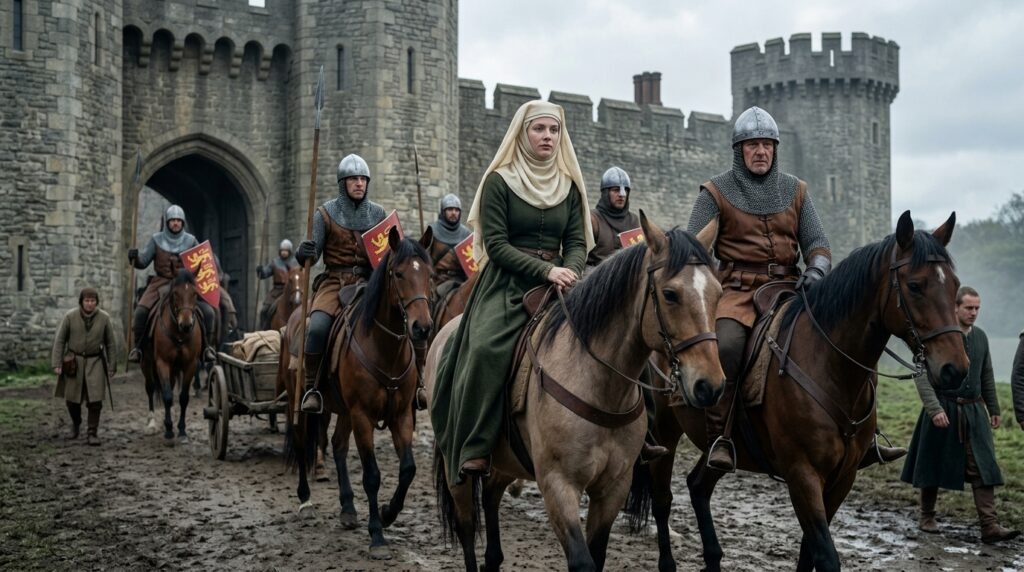
Liberation and the Aftermath of Bannockburn (1314)
The turning point in the life of Elizabeth de Burgh, Queen of Scots, came in June 1314 on the battlefield of Bannockburn near Stirling.
The Prisoner Exchange
At Bannockburn, Robert the Bruce won a crushing victory over Edward II’s army, capturing dozens of high-ranking English nobles, including Humphrey de Bohun, 4th Earl of Hereford.

Bruce utilized the Earl of Hereford as leverage to demand the immediate release of his family. In the autumn of 1314, an official prisoner exchange was negotiated at Carlisle:
After eight painful years of separation and captivity, Queen Elizabeth de Burgh returned across the border to Scotland in November 1314, reunited with her husband at the age of thirty.

Queen Consort of Scotland and Royal Children
Upon her return, Elizabeth resumed her role as Queen Elizabeth de Burgh, assisting her husband in rebuilding a war-torn nation and securing the royal succession.
Securing the House of Bruce
For many years, the primary dynastic anxiety facing Robert the Bruce and Elizabeth de Burgh was the lack of a male heir. Elizabeth gave birth to two daughters, Margaret and Matilda, but the crown’s security remained uncertain.

The relief of the nation was immense when, on March 5, 1324, at Dunfermline Palace, Queen Elizabeth gave birth to twin sons: David and John. Although baby John died in infancy, Prince David survived, securing the legitimate male succession for the House of Bruce.

Elizabeth de Burgh Cause of Death and Final Days
As Scotland secured its independence through military victories and diplomatic recognition from the Papacy, Queen Elizabeth’s health began to decline.

What Was Elizabeth de Burgh's Cause of Death?
Historical records regarding Elizabeth de Burgh cause of death point to a tragic riding accident combined with failing health.
In late October 1327, while residing at the royal residence of Cullen in Banffshire, Queen Elizabeth fell from her horse during a journey. She sustained severe internal injuries from the fall. Weakened by the physical trauma and the lasting physical toll of her eight years of English captivity, she died several days later on October 27, 1327, at the age of forty-three.

Funeral and Dual Burial Sites
Following her death, her body was treated according to royal medieval customs:
- The Organ Burial at Cullen: Her internal organs were removed and buried at the Church of St. Mary the Virgin in Cullen. Grieving her loss, King Robert the Bruce established a perpetual chaplaincy at Cullen to pray for her soul, an endowment that continues to be commemorated in the parish today.
- Royal Interment at Dunfermline: Her body was transported south and buried with full royal state at Dunfermline Abbey—the traditional burial site of Scottish monarchs. When Robert the Bruce died eighteen months later in June 1329, he was interred directly beside her beneath a magnificent marble tomb imported from Paris.

Essential Historical Summary: Elizabeth de Burgh
For quick reference, the following structured summary outlines essential details regarding the life and legacy of Queen Elizabeth de Burgh:
- Full Royal Name: Queen Elizabeth de Burgh (Elizabeth de Burgh, Queen of Scots).
- Dates of Life: c. 1284 – October 27, 1327 (Aged 43).
- Parents: Richard Óg de Burgh, 2nd Earl of Ulster ("The Red Earl"), and Margaret de Burgh.
- Spouse: King Robert I of Scotland (Robert the Bruce) (m. 1302).
- Coronation: Crowned Queen Consort of Scots at Scone Abbey on March 27, 1306.
- Period of Imprisonment: October 1306 – November 1314 (8 Years under English house arrest).
- Royal Children: Margaret, Matilda, King David II of Scotland, John of Carrick.
- Cause of Death: Internal injuries sustained in a riding accident at Cullen in October 1327.
- Burial Sites: Entrails at St. Mary's, Cullen; body at Dunfermline Abbey.

Recommended Books and Reading Material
For readers, researchers, and history enthusiasts seeking to explore primary sources, academic biographies, and historical studies on Elizabeth de Burgh and the Wars of Scottish Independence, the following works are highly recommended:
- Robert the Bruce: King of Scots by Ronald McNair Scott. An outstanding, highly readable biography analyzing the political alliance, marriage, and captivity of Elizabeth de Burgh.
- The Wars of Scotland, 1214–1371 by Michael Brown. An authoritative academic study detailing the geopolitical ties between Ireland, Scotland, and England during the Bruce campaign.
- In the Footsteps of Robert the Bruce by Caroline Bingham. A rich historical survey exploring the castles, manors, and sanctuaries associated with Elizabeth de Burgh and the royal court.
- Daughters of the North: Jean Gordon and Domestic Life in Medieval Scotland by Margaret H. B. Sanderson. A valuable interdisciplinary work examining the social, legal, and domestic roles of noblewomen in medieval Scotland.
- The Chronicle of Lanercost (1201–1346) translated by Sir Herbert Maxwell. A primary fourteenth-century monastic chronicle offering contemporary English accounts of Elizabeth's capture, warning, and imprisonment.
Recommended video
Frequently Asked Questions About Elizabeth de Burgh (FAQ)
Explore the answers to the ten most common historical queries regarding the life, marriage, imprisonment, and death of Elizabeth de Burgh.
1. Who was Elizabeth de Burgh?
In medieval studies, scholars identify Elizabeth de Burgh as an Anglo-Norman noblewoman from Ireland who became Elizabeth de Burgh, Queen of Scots, through her 1302 marriage to King Robert the Bruce.
2. Was Elizabeth de Burgh kept in a cage during her imprisonment?
Historians investigating whether was Elizabeth de Burgh kept in a cage clarify that she was not. While her relatives Mary Bruce and Isabella of Buchan were caged at Berwick and Roxburgh, Queen Elizabeth de Burgh was held under strict house arrest at English manors because she was Edward I's goddaughter and daughter of the Earl of Ulster.
3. What was Elizabeth de Burgh's cause of death?
Historical records concerning Elizabeth de Burgh cause of death show that she died on October 27, 1327, after suffering severe internal injuries from a riding fall at Cullen in Banffshire.
4. How old was Elizabeth de Burgh when she married Robert the Bruce?
Researching how old was Elizabeth de Burgh when she married reveals she was approximately eighteen years old when she wed Robert the Bruce in 1302 at Writtle, Essex.
5. What defined the relationship between Robert the Bruce and Elizabeth de Burgh?
The union of Robert the Bruce and Elizabeth de Burgh began as a diplomatic alliance in 1302. Despite eight years of painful separation during her English captivity, she returned to Scotland in 1314, giving birth to future King David II.
6. How long was Elizabeth de Burgh held captive in England?
She was held captive for eight years, from her arrest at St. Duthac in late 1306 until her release following the Battle of Bannockburn in late 1314.
7. Who were her parents and family background?
She was the daughter of Richard Óg de Burgh, 2nd Earl of Ulster (the "Red Earl"), the most powerful Anglo-Norman lord in Ireland, and his wife Margaret.
8. Where is Elizabeth de Burgh buried?
Her body is buried at Dunfermline Abbey beside King Robert the Bruce, while her internal organs were interred at St. Mary's Church in Cullen.
9. How was Elizabeth de Burgh liberated from captivity?
Following the victory at Bannockburn in 1314, Robert the Bruce exchanged the captured Earl of Hereford for Elizabeth, Marjorie Bruce, and Bishop Wishart.
10. What children did Elizabeth de Burgh have with Robert the Bruce?
Her children included Margaret Bruce, Matilda Bruce, Prince John (who died in infancy), and King David II of Scotland.
Si quieres conocer otros artículos parecidos a Elizabeth de Burgh: Queen of Scots, Dynastic Hostage, and Royal Matriarch puedes visitar la categoría Queens of Scotland.