
The Battle of the Plains of Abraham: The Climax of the Seven Years' War in North America


- Introduction to the Battle of the Plains of Abraham in 1759
- The Strategic Stalemate of the Quebec Campaign
- The Midnight Gamble: Scaling the Cliffs of L'Anse-au-Foulon
- Two Commanders, One Destiny: Wolfe and Montcalm
- The Clash of Regulars and Irregulars
- The Fatal Volleys and the Collapse of New France
- The Immediate Fall of Quebec and the Aftermath
- Geopolitical Significance: The Birth of a New Continent
- Recommended Books and Further Reading
- Recommended video
- Frequently Asked Questions About the Battle of the Plains of Abraham (FAQ)
Introduction to the Battle of the Plains of Abraham in 1759
The fate of a continent can alter course in a single morning. On September 13, a brief but spectacularly violent engagement outside the stone walls of Quebec permanently broke the back of the French Empire in the New World. The historic battle of the plains of Abraham in 1759 stands as the definitive turning point of the French and Indian War, which was the North American theater of the global Seven Years' War.
For generations, France and Great Britain had locked horns over the vast, resource-rich wilderness of North America. When hostilities boiled over into open systemic warfare, the strategic gateway of New France became the ultimate prize. The cliffside stronghold of Quebec City commanded the St. Lawrence River, acting as an impenetrable cork in the bottle of French trade and military logistics. To capture it was to conquer the colony; to lose it was to abandon the interior of the continent.
Understanding the deep battle of the plains of Abraham summary requires looking beyond a simple clash of musketry. It was a masterpiece of desperate amphibious operations, an immense gamble by an eccentric British general, and a tragic comedy of errors by a French command that underestimated the speed of their adversary. Today, the legendary fields of Quebec remain a subject of intense emotional memory, deep historical study, and geopolitical consequence.
The Strategic Stalemate of the Quebec Campaign
To fully comprehend how the opposing forces arrived at this fateful crossroad, one must look at the immense frustrations characterizing the summer months of 1759. The British expeditionary force, arriving on a massive armada of over two hundred ships commanded by Vice-Admiral Charles Saunders, had laid siege to Quebec since June. Yet, as August bled into September, the fortress remained defiantly secure.

The British land forces were commanded by Major General James Wolfe, a frail, sickly, yet hyper-aggressive 32-year-old officer. Facing him behind the fortified lines of the city was Lieutenant General Louis-Joseph de Montcalm, a seasoned French aristocrat who understood that he did not need to defeat the British in open battle; he merely needed to survive until the brutal Canadian winter forced the enemy fleet to retreat downriver to avoid being crushed by ice.

Montcalm established a formidable defensive line along the Beauport shore, northeast of the city. Wolfe attempted several direct assaults, most notably at the Battle of Beauport on July 31, where British forces were bloodily repulsed with hundreds of casualties. Frustrated by his failures and racked by a severe fever, Wolfe resorted to a campaign of psychological warfare, ordering his troops to burn colonial farms and villages throughout the countryside to bait the French out of their fortifications. Still, Montcalm remained disciplined, holding his elite regular regiments in check behind their secure defensive earthworks.

The Midnight Gamble: Scaling the Cliffs of L'Anse-au-Foulon
With time rapidly running out and his own officers openly questioning his erratic leadership, Wolfe conceived a desperate, highly secretive operational plan. Rather than attacking the heavily fortified Beauport lines again, he decided to strike where the French least expected an assault: the steep, precipitous cliffs southwest of the city at a small cove called L'Anse-au-Foulon.

The Amphibious Ascent
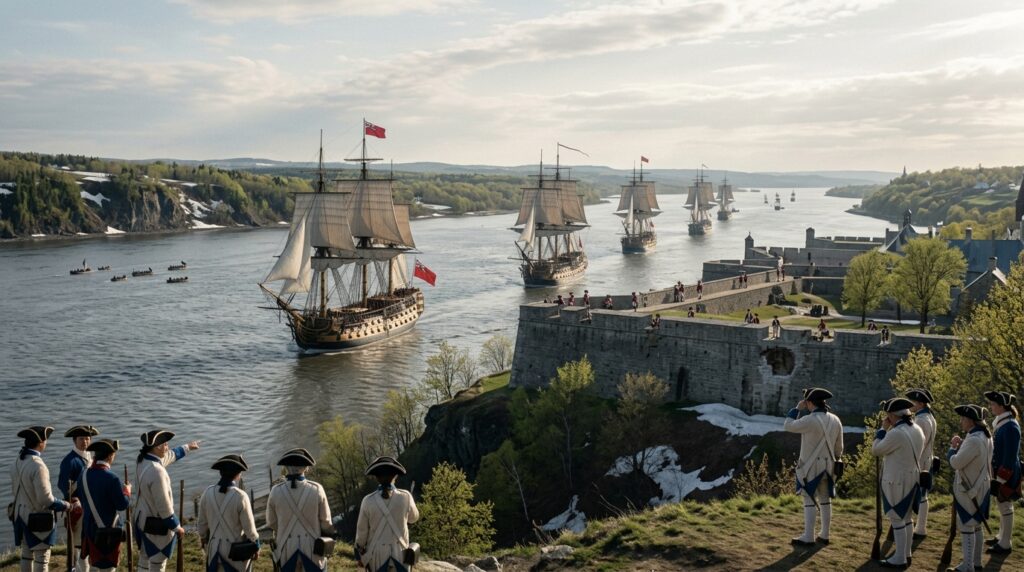
In the pitch-black darkness of the early morning hours of September 13, British flat-bottomed boats slipped silently down the St. Lawrence River, riding the powerful ebbing tide. French sentries stationed along the shoreline heard the splashing oars, but British officers fluent in French answered the challenges, deceiving the guards into believing a long-awaited French provisions convoy was passing by.

Upon reaching L'Anse-au-Foulon, a vanguard of elite British light infantry, led by Colonel William Howe, scrambled up the narrow, overgrown path covering the 170-foot cliff face. They quickly overwhelmed the small French outpost at the summit, which was guarded by a sleepy detachment under the relaxed command of Louis Du Pont de Duchambon de Vergor. By the time the sun began to rise over the river, Wolfe had successfully landed nearly 4,400 regular soldiers on the high plateau above the city.

Deploying Across the Plains
The terrain chosen for the confrontation was a relatively flat, open agricultural plateau named after a historic 17th-century fisherman and farmer, Abraham Martin. Deploying his troops across this landscape, Wolfe formed a classic thin red line that stretched across the fields, effectively blocking any movement or supply lines between Quebec City and the French forces stationed further west at Cap-Rouge.

To visual learners analyzing a battle of the plains of Abraham map, the tactical positioning reveals an immense vulnerability: Wolfe had no line of retreat. If the French could trap him against the cliff's edge, his army would be completely annihilated. He was banking everything on the superior discipline of his professional redcoats in a traditional European-style formal battle.

Two Commanders, One Destiny: Wolfe and Montcalm
The impending clash represented a classic confrontation between two completely different military philosophies, leadership backgrounds, and national doctrines. Both men were veterans of bloody continental European wars, yet both found themselves commanding armies in a rugged, unpredictable wilderness that defied conventional military theory.

Major General James Wolfe: The Brilliant Zealot
James Wolfe was an unconventional commander who possessed a fanatical dedication to military discipline and tactical innovation. Despite suffering from chronic illnesses, his courage was undeniable, often positioning himself at the very front of his troops during moments of extreme danger.

Wolfe had spent years perfecting the training of his infantry, emphasizing rapid, synchronized reloading techniques and absolute coolness under devastating fire. On the morning of September 13, he dressed in a brand-new, brilliant scarlet uniform, making himself a highly visible target for French sharpshooters, but ensuring his men could see him leading from the vanguard.

Lieutenant General Louis-Joseph de Montcalm: The Trapped Defender
The Marquis de Montcalm was a highly competent, deeply aristocratic officer who had won a string of stunning victories for France earlier in the war, including the captures of Fort Oswego and Fort William Henry, and his brilliant defensive masterpiece at Carillon in 1758. However, his relationship with the Canadian-born Governor General, Pierre de Rigaud de Vaudreuil, was poisonous.

The two leaders constantly bickered over strategy, with Vaudreuil favoring traditional frontier guerrilla warfare using indigenous allies and Canadian militia, while Montcalm despised the irregulars and favored classic European siege and line tactics. When Montcalm learned that the British had successfully scaled the cliffs, he panicked, believing that if he did not strike immediately, the British would have time to entrench themselves irreversibly and starve the city into submission.

The Clash of Regulars and Irregulars
When looking at the composition of the forces that morning, Montcalm's army was a fragile mixture of elite French regulars (Troupes de Terre), naval troops (Troupes de la Marine), and poorly trained local Canadian militia. Rather than waiting for the 2,000 elite regular troops under Louis Antoine de Bougainville to march back from Cap-Rouge and trap Wolfe in a pincer movement, Montcalm decided to attack immediately with the 4,500 men he had on hand.

As the French columns advanced across the battle of the plains of Abraham field, their alignment began to break apart. The Canadian militia and indigenous warriors, accustomed to fighting from the cover of forests and brush, threw themselves onto the grass to fire individually before reloading, throwing the advancing French regular formations into tactical confusion. The French columns drifted apart, their lines zig-zagging and losing cohesion before they even came within effective firing range of the British line.

In contrast, Wolfe's redcoats stood like a literal stone wall. To maximize the destructive power of his tactics, Wolfe had ordered his men to double-load their muskets with two musket balls each. He instructed his regiments to remain completely silent and hold their fire until the advancing French columns were within a mere forty yards. This required superhuman discipline, as French bullets began tearing through the British ranks, killing officers and thinning the red lines while the men stood shoulder-to-shoulder, waiting for the command to fire.

The Fatal Volleys and the Collapse of New France
The climax of the battle of the plains of Abraham lasted only a few terrifying minutes. When the disorganized French columns finally closed the distance to forty yards, the British command gave the signal.

The Perfect Volley
A single, synchronized roar tore across the plateau, described by contemporary witnesses as sounding like a sudden, massive clap of thunder. The double-loaded British volley tore through the French ranks with catastrophic effect, wiping out entire front ranks in a matter of seconds.

Before the smoke could even clear, the British advanced forward twenty paces and unleashed a second, equally devastating volley. The French regular regiments, shattered by the horrific casualties and throwing down their weapons, broke formation and fled in terror back toward the safety of the city walls or across the St. Charles River.

The Deaths of the Heroes
The absolute victory came at a terrible personal cost for both empires. During the peak of the British advance, James Wolfe was struck three times—first in the wrist, then in the stomach, and finally in the chest by a fatal musket ball. As he lay dying on the field, an officer cried out that the French were running. Upon hearing the news, Wolfe gave a final tactical order to cut off their retreat, whispered "Now, God be praised, I will die in peace," and expired on the field.

Moments later, as he attempted to rally his retreating troops near the city gates, the Marquis de Montcalm was mortally wounded by a burst of British grapeshot through the abdomen. Carried into the city by his loyal officers, he was informed by a surgeon that his wounds were fatal. Montcalm reportedly responded with relief, stating that he was glad he would not live to see the formal surrender of Quebec. He died early the next morning and was buried in a shell crater beneath the floor of the Ursuline convent church.

The Immediate Fall of Quebec and the Aftermath
With both commanders dead and the French field army scattered in absolute disarray, the defense of the colony dissolved completely. Governor Vaudreuil abandoned the city, ordering the garrison to retreat eastward toward Montreal. On September 18, 1759, the fortress of Quebec formally opened its gates and surrendered to British forces.
| Combatant Force | Initial Strength | Estimated Casualties (Killed/Wounded) |
| British Regulars (Wolfe) | ~4,400 | ~650 |
| French Mixed Army (Montcalm) | ~4,500 | ~650 |
While the immediate battle of the plains of Abraham summary notes identical casualty figures of around 650 men on each side, the strategic impact was entirely asymmetrical. The loss of Quebec severed the primary artery of the French empire in North America.

Although the French launched a successful counter-attack the following spring at the Battle of Sainte-Foy under the Chevalier de Lévis, forcing the British back behind the city walls, the arrival of British reinforcement ships in May 1760 sealed the fate of New France permanently. By September 1760, Montreal surrendered, ending all French military resistance on the continent.
Geopolitical Significance: The Birth of a New Continent
The profound historical significance of the battle of the plains of Abraham in 1759 cannot be overstated. When the Treaty of Paris was formally signed in 1763, France ceded nearly all of its North American territories east of the Mississippi River to Great Britain, including Canada, Cape Breton, and the rich fishing grounds of the region.

Furthermore, this historic shift sparked an unexpected chain reaction that reshaped world history. With the French threat removed from their northern border, the American colonists no longer felt dependent on British military protection.

When the British government began imposing heavy taxes on the thirteen colonies to pay off the massive war debts incurred during the Seven Years' War, it ignited the flames of political dissent. Thus, the British victory on the plains of Abraham inadvertently cleared the structural pathway for the American Revolution and the birth of the United States less than two decades later.

Recommended Books and Further Reading
If this extensive look at the battle has sparked your interest and you wish to explore the rich history, military letters, and complex cultural legacy of this monumental clash in deeper detail, we highly recommend the following historical works:
- "Northern Armies: The Battle for North America" by Francis Parkman.A classic, sweeping narrative history that captures the romanticism, tragedy, and intense personal dynamics of Wolfe and Montcalm.
- "The Plains of Abraham: The Search for the Ideological Roots of Canada" by Brian Young.A brilliant academic examination of how the memory of the 1759 battle has been used, interpreted, and romanticized by French and English Canadians.
- "Quebec 1759: The Siege and the Battle" by C.P. Stacey.Widely regarded as the definitive military history of the campaign, offering an incredibly objective analysis of the tactical decisions on both sides.
- "Death or Victory: The Battle for Quebec and the Birth of an Empire" by Dan Snow.A fast-paced, modern history utilizing newly discovered letters and logs to recreate the harrowing midnight amphibious landing with immense clarity.
Recommended video
Frequently Asked Questions About the Battle of the Plains of Abraham (FAQ)
Explore the answers to the most common queries regarding the tactical deployments, leadership decisions, and historic consequences surrounding this iconic North American clash.
Who won the Battle of the Plains of Abraham and what were the long-term results?
When analyzing the final outcome of the historic battle of the plains of abraham, records confirm a total victory for the British forces. The turning point occurred when the disciplined redcoats shattered the French lines, ensuring that the global battle of the plains of abraham summary would be recorded as the moment Great Britain gained control of Canada.
Where exactly is the Battle of the Plains of Abraham site located?
For historians mapping out the terrain, the precise battle of the plains of abraham map coordinates place the battlefield on a high plateau in Quebec. The core engagement occurred just outside the western stone walls of the old citadel, turning these open agricultural fields into a permanent symbol of Canadian historical memory.
How did General James Wolfe manage to surprise the French forces?
The success of the British strategy relied entirely on the midnight amphibious assault that marked the opening phase of the battle of the plains of abraham in 1759. By scaling the precipitous cliffs at L'Anse-au-Foulon in absolute darkness, Wolfe bypassed the primary French defensive fortifications located along the Beauport shore.
Why did the Marquis de Montcalm attack immediately instead of waiting for reinforcements?
As detailed in tactical histories, Montcalm panicked upon seeing British infantry deployed across the open plateau. He feared that allowing the British time to entrench would result in a total blockade of Quebec, forcing him to engage in an open-field clash before Bougainville's elite detachment could return to assist him.
What was the human cost of the Battle of the Plains of Abraham in 1759?
The human toll was incredibly symmetrical, with both sides suffering roughly 650 casualties. However, the most profound loss was the death of both supreme commanders; Wolfe died directly on the fields of the plains of abraham, while Montcalm succumbed to his wounds inside the city the following morning.
Si quieres conocer otros artículos parecidos a The Battle of the Plains of Abraham: The Climax of the Seven Years' War in North America puedes visitar la categoría Battles of Canada.