
Chief Te Rauparaha: Master Strategist, Warrior, and Architect of Ngāti Toa Power


In the turbulent landscape of early nineteenth-century Aotearoa New Zealand, few historical figures cast a longer or more imposing shadow than Chief Te Rauparaha. A paramount rangatira (chief) and war leader of the Ngāti Toa iwi (tribe), he was a master of traditional amphibious warfare, a brilliant political strategist, and an adept negotiator in early European trade networks.
Known across the South Pacific as a military genius whose tactical acumen earned him the nickname "the Napoleon of the South," Te Rauparaha orchestrated one of the most remarkable tribal migrations in Māori history. Driven south from his ancestral lands at Kawhia by powerful northern enemies armed with European muskets, he led Ngāti Toa on a hazardous trek to Kapiti Island and the Cook Strait region. From this strategic maritime stronghold, he established a dominant trade and military empire spanning the lower North Island and upper South Island.
Beyond his military exploits, Rauparaha is universally recognized as the composer of Ka Mate, the world-famous Haka performed globally by New Zealand's national rugby team, the All Blacks.
This comprehensive historical study explores the life, political vision, military campaigns, personal composition, and permanent legacy of Te Rauparaha.
- Early Life, Ancestry, and the Crucible of Kawhia
- The Great Migration: Te Heke Tākitimu and Te Heke Niho Puta
- The Origin of the Haka "Ka Mate"
- The Conquest of Kapiti Island and Maritime Empire
- South Island Campaigns: The Conquest of Te Wai Pounamu
- Conflict with British Settlers: The Wairau Affray (1843)
- Arrest, Imprisonment, Return, and Death
- Historical Assessment and Permanent Legacy
- Essential Biographical Summary: Chief Te Rauparaha
- Recommended Books and Reading Material
- Recommended video
- Frequently Asked Questions About Te Rauparaha (FAQ)
Early Life, Ancestry, and the Crucible of Kawhia
Lineage and Childhood at Kawhia
To understand his rise to power, one must examine any detailed biography of Te Rauparaha. Born around 1770 at Kawhia on the rugged west coast of the North Island, Te Rauparaha was the son of Werawera, a chief of Ngāti Toa, and Parekōwhai (also known as Huhuti), a chieftainess of Ngāti Raukawa. Through both parental lines, young Te Rauparaha inherited high-born mana (spiritual authority and prestige) tracing back to the crew of the historic Tainui voyaging waka.

Despite his high lineage, Te Rauparaha was not initially expected to become a supreme war leader due to his relatively small physical stature during youth. However, what he lacked in size he compensated for with exceptional intelligence, physical agility, ruthless determination, and an unmatched grasp of human psychology.

The Arrival of Firearms and the Northern Threat
By the 1810s, the introduction of European flintlock muskets to northern tribes—most notably Ngāpuhi under Chief Hongi Hika—drastically altered the traditional balance of power across the North Island.

Ngāti Toa's traditional enemies, the Waikato and Maniapoto confederations, acquired muskets and launched devastating invasions into the Kawhia region. Realizing that Ngāti Toa could not defend their ancestral homeland against numerically superior, musket-armed forces, Chief Te Rauparaha formulated a bold, historic decision: he would abandon Kawhia and lead his entire iwi on a migration south to establish a new empire.

The Great Migration: Te Heke Tākitimu and Te Heke Niho Puta
The Journey South (1821–1822)
In 1821, Te Rauparaha initiated Te Heke Tākitimu (The Migration of the Tākitimu), leading hundreds of Ngāti Toa men, women, and children on an arduous journey of over 300 miles down the western coast of the North Island.

The migration was a masterpiece of military logistics and political diplomacy. Facing hostile tribes along the route, Te Rauparaha negotiated passage, fought rearguard battles, and forged crucial military alliances with his mother's tribe, Ngāti Raukawa, and the Te Āti Awa iwi.

The Origin of the Haka "Ka Mate"
Pursued by Enemies at Lake Rotoaira
It was during the tense early years of tribal conflict surrounding his migrations (c. 1820) that Te Rauparaha composed the legendary haka, Ka Mate.

According to oral accounts detailed in any comprehensive Te Rauparaha's biography, he was pursued by a war party from the Ngāti Te Wharepurangi and Ngāti Tūwharetoa tribes. Seeking refuge near Lake Rotoaira, he approached a friendly chief named Wharerangi for protection.

Wharerangi instructed Te Rauparaha to hide in a deep rua kūmara (sweet potato storage pit) and had his wife, Te Rangikoaea, sit over the entrance. In traditional Māori belief, the spiritual presence of a high-born woman neutralized the harmful magical spells (karearea) used by pursuers.

The Words of Ka Mate
As Te Rauparaha lay in the dark pit hearing the footsteps of enemy warriors searching above, he whispered to himself: "Ka mate, ka mate" ("I die, I die"). When Wharerangi convinced the pursuers to leave, Te Rauparaha felt the cover lifted, flooding the pit with sunlight, and exclaimed: "Ka ora, ka ora!" ("I live, I live!").

Emerging from the pit, he performed the dramatic chant that remains famous worldwide:
"Ka mate! Ka mate! Ka ora! Ka ora!
Ka mate! Ka mate! Ka ora! Ka ora!
Tēnei te tangata pūhuruhuru
Nāna nei i tiki mai whakawhiti te rā!
Upane! Upane! Upane, kaupane!
Whiti te rā!"
(Will I die? Will I die? I live! I live!
This is the hairy man who brought the sun and made it shine!
Step upward! Step upward! Up to the top!
The sun shines!)

The Conquest of Kapiti Island and Maritime Empire
The Strategic Value of Kapiti Island
By 1823, Chief Te Rauparaha seized Kapiti Island from its original inhabitants, the Muaūpoko iwi. Kapiti Island proved to be an impregnable natural fortress: an offshore island protected by treacherous ocean currents, featuring high lookout cliffs and secure anchorages.
From Kapiti Island, Te Rauparaha established absolute control over Cook Strait (Te Moana-o-Raukawa), controlling the vital trade routes between the North and South Islands.

The Battle of Waiorua (1824)
Recognizing the growing power of Ngāti Toa, a massive coalition of southern tribes—comprising Muaūpoko, Rangitāne, Ngāti Apa, and South Island iwi—assembled a fleet of over 2,000 warriors in war canoes to attack Kapiti Island.

In the pre-dawn darkness at Waiorua on the northern end of Kapiti, Te Rauparaha executed a brilliant counter-attack. Utilizing concentrated musket fire alongside ferocious hand-to-hand charges, Ngāti Toa shattered the invading armada, establishing permanent dominance over the region.

South Island Campaigns: The Conquest of Te Wai Pounamu
The Elizabeth Affair (1830)
Seeking to expand his influence into the South Island (Te Wai Pounamu) to secure valuable pounamu (greenstone/jade) resources and avenge ancestral defeats, Te Rauparaha conducted daring naval expeditions against the Ngāi Tahu iwi.

In 1830, Te Rauparaha orchestrated one of the most controversial incidents in early New Zealand history: the Elizabeth Affair. He chartered a British trading captain, John Stewart of the brig Elizabeth, to secretly transport 100 Ngāti Toa warriors to Akaroa on the Banks Peninsula.

Hiding in the vessel's hold, Ngāti Toa warriors captured the paramount Ngāi Tahu chief, Tama-i-hara-nui, his wife, and daughter. The campaign resulted in the destruction of the Akaroa settlement and established Ngāti Toa's military reach across the upper South Island.

The Siege of Kaiapoi Pā (1831)
In 1831, Te Rauparaha led a massive expedition against Kaiapoi Pā, the principal fortified stronghold of Ngāi Tahu near modern-day Christchurch. After a three-month siege, Ngāti Toa sap-mined the fortress palisades using bundles of dry manuka scrub, setting fire to the defenses and capturing the pā.

| Campaign / Event | Date | Opposing Iwi / Forces | Historical & Geopolitical Significance |
| Te Heke Tākitimu | 1821–1822 | Waikato / Maniapoto | 300-mile migration of Ngāti Toa to southern North Island. |
| Battle of Waiorua | 1824 | Southern Iwi Coalition | Defeated 2,000 invading warriors at Kapiti Island. |
| Elizabeth Affair | 1830 | Ngāi Tahu (Akaroa) | Amphibious raid using chartered British vessel Elizabeth. |
| Siege of Kaiapoi | 1831 | Ngāi Tahu (Canterbury) | Capture of major South Island greenstone trade center. |
| Wairau Affray | 1843 | NZ Company / Settlers | First armed clash between Crown settlers and Māori forces. |
Conflict with British Settlers: The Wairau Affray (1843)
Tensions with the New Zealand Company
Following the signing of the Treaty of Waitangi in 1840—which Te Rauparaha signed on two separate occasions after demanding assurances that Māori land sovereignty would be respected—thousands of British settlers arrived under the auspices of the New Zealand Company.

In 1843, representatives of the New Zealand Company unilaterally claimed ownership of the fertile Wairau Valley in the South Island, attempting to survey the land despite fierce objections from Chief Te Rauparaha and his nephew, Te Rangihaeata.

The Wairau Clash
When survey huts were burned down by Ngāti Toa on land they had never sold, an armed party of twenty-four British settlers and magistrates led by Captain Arthur Wakefield marched into the Wairau Valley to arrest Te Rauparaha.

On June 17, 1843, a tense standoff erupted on the banks of the Tuamarina Stream. An accidental shot fired by a settler killed Te Rangihaeata's wife, Te Rongo. In the ensuing battle, twenty-two British settlers and four Māori were killed.

Governor Robert FitzRoy investigated the incident and officially exonerated Te Rauparaha, ruling that the New Zealand Company had acted illegally and provoked the tragic conflict.

Arrest, Imprisonment, Return, and Death
Abduction by Governor Grey (1846)
In 1846, as conflict erupted in the Hutt Valley between colonial forces and discontented Māori leaders, the newly appointed Governor, Sir George Grey, viewed Rauparaha as a dangerous threat to British colonial rule.

On July 23, 1846, Grey ordered a surprise dawn raid on Te Rauparaha's camp at Taupō (near modern-day Plimmerton). British troops seized the aging chief in his bed, dragging him aboard HMS Calliope. He was held as a prisoner of state without trial for eighteen months aboard naval ships and under house arrest in Auckland.

Final Years at Ōtaki and Passing
Released in 1848 after Governor Grey satisfied himself that Ngāti Toa's power had been neutralized, Te Rauparaha returned to his people at Ōtaki.

In his final years, the elderly war leader embraced Christianity and focused his remaining energy on spiritual reconciliation and community building. He supervised the construction of the magnificent Rangiātea Church in Ōtaki, a masterpiece of traditional Māori woodcarving combined with European church architecture.
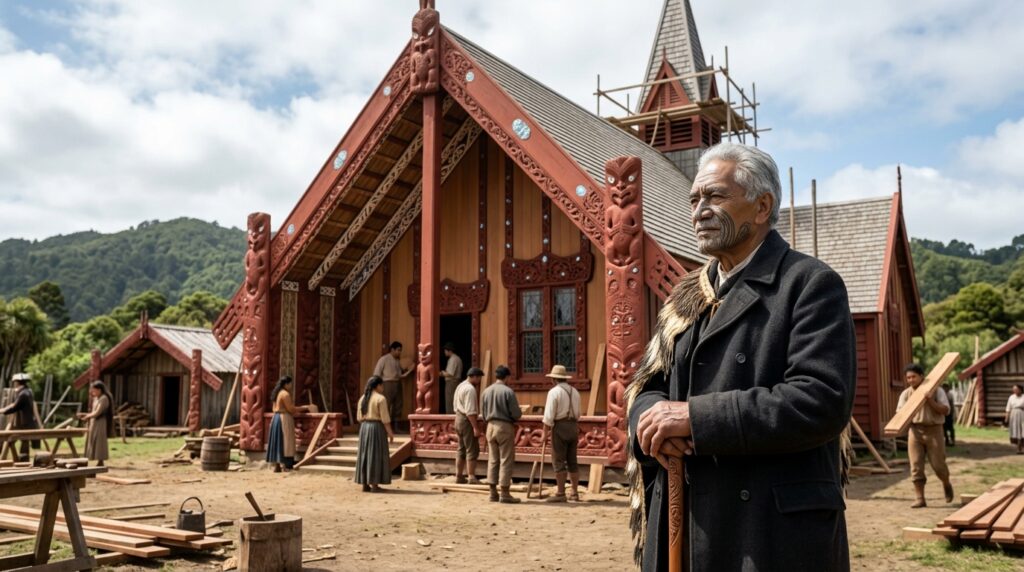
On November 27, 1849, Chief Te Rauparaha passed away at Ōtaki at approximately seventy-nine years of age. He was initially buried near Rangiātea Church, though oral traditions hold that his loyal warriors secretly reinterred his body on his beloved Kapiti Island.

Historical Assessment and Permanent Legacy
Historiographical Re-evaluation
Over two centuries, historical evaluation of Te Rauparaha has undergone significant transformation:
Modern historians, military analysts, and Indigenous scholars evaluate Te Rauparaha as one of the most formidable statesmen and military commanders in Pacific history. His strategic genius preserved the existence of Ngāti Toa, established vibrant maritime trade networks, and shaped the political geography of central New Zealand.

Essential Biographical Summary: Chief Te Rauparaha
For quick reference, the following structured breakdown summarizes essential historical details regarding the life and career of Te Rauparaha:
- Name / Title: Chief Te Rauparaha (Paramount War Leader of Ngāti Toa).
- Dates of Life: c. 1770 – November 27, 1849.
- Tribal Affiliation: Ngāti Toa (Tainui Waka).
- Key Achievements: Led the 300-mile migration (Te Heke Tākitimu); captured Kapiti Island and established Cook Strait maritime empire; composed world-famous haka Ka Mate; built Rangiātea Church at Ōtaki.
- Primary Stronghold: Kapiti Island, New Zealand.
- Burial Location: Ōtaki / Kapiti Island, New Zealand.

Recommended Books and Reading Material
For researchers, students, and history enthusiasts wishing to explore primary colonial records, Māori oral traditions, and academic biographies of Te Rauparaha, the following works are highly recommended:
• Te Rauparaha: A Biography by Patricia Burns. An outstanding, meticulously researched biography examining his military strategies, political decisions, and imprisonment.
• Life and Times of Te Rauparaha by Tamihana Te Rauparaha (edited by Peter Butler). An invaluable primary source written directly by Te Rauparaha's son, offering firsthand oral accounts of his father's life and campaigns.
• The Musket Wars: A History of Inter-iwi Conflict 1806–45 by James Belich. An award-winning military history detailing how Te Rauparaha utilized firearms and amphibious tactics to conquer Cook Strait.
• Ka Mate: The King of Haka by Wira Gardiner. A detailed historical work examining the composition, cultural meaning, and global evolution of Te Rauparaha's famous haka.
• Tangata Whenua: A History of New Zealand Māori by Atholl Anderson, Judith Binney, and Aroha Harris. A sweeping, authoritative historical text exploring Ngāti Toa's migrations and the nineteenth-century colonial environment.
Recommended video
Frequently Asked Questions About Te Rauparaha (FAQ)
Explore the answers to the ten most common queries regarding the life, conquests, haka composition, and legacy of Chief Te Rauparaha.
1. Who was Chief Te Rauparaha?
When exploring Pacific history, scholars identify Chief Te Rauparaha as a paramount war leader of Ngāti Toa, a military strategist, and the composer of the famous haka Ka Mate.
2. Why did Te Rauparaha compose the haka Ka Mate?
As recorded in any detailed te rauparaha biography, he composed Ka Mate around 1820 while hiding from enemy pursuers in a sweet potato pit at Lake Rotoaira, celebrating his survival.
3. What was the Great Migration of Ngāti Toa?
The Great Migration (*Te Heke Tākitimu*) was the 300-mile relocation led by rauparaha in 1821–1822, moving his tribe from Kawhia to Kapiti Island to escape musket-armed northern enemies.
4. Why was Kapiti Island central to his power?
Kapiti Island provided Te Rauparaha with an offshore naval fortress from which he controlled Cook Strait shipping, taxed European whaling fleets, and launched South Island expeditions.
5. What occurred during the Wairau Affray of 1843?
The Wairau Affray was an armed clash between British settlers and Ngāti Toa forces over illegal land surveying, resulting in Governor FitzRoy exonerating Chief Te Rauparaha.
6. Why was he arrested by Governor George Grey in 1846?
Governor Grey seized Te Rauparaha in a surprise dawn raid at Plimmerton to neutralize his political influence during the Hutt Valley campaign, holding him without trial for eighteen months.
7. Did Te Rauparaha sign the Treaty of Waitangi?
Yes, Te Rauparaha signed the Treaty of Waitangi on two separate occasions in May and June 1840 after receiving explicit assurances that tribal land rights would be protected.
8. What was his nickname among European officers?
European observers referred to Te Rauparaha as "the Napoleon of the South" in recognition of his mobility, strategic intellect, and mastery of amphibious warfare.
9. What church project did he champion before his death?
In his final years at Ōtaki, rauparaha supervised the construction of Rangiātea Church, a landmark uniting traditional Māori woodcarving with Christian architecture.
10. Where is Chief Te Rauparaha buried?
He was buried in 1849 near Rangiātea Church in Ōtaki, though oral traditions hold that his loyal warriors secretly reinterred his body on Kapiti Island.
Si quieres conocer otros artículos parecidos a Chief Te Rauparaha: Master Strategist, Warrior, and Architect of Ngāti Toa Power puedes visitar la categoría Māori Chiefs New Zealand.